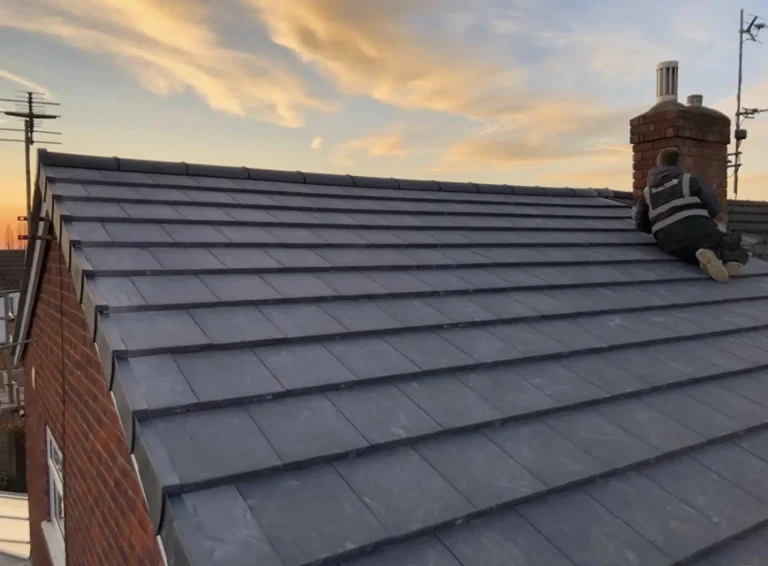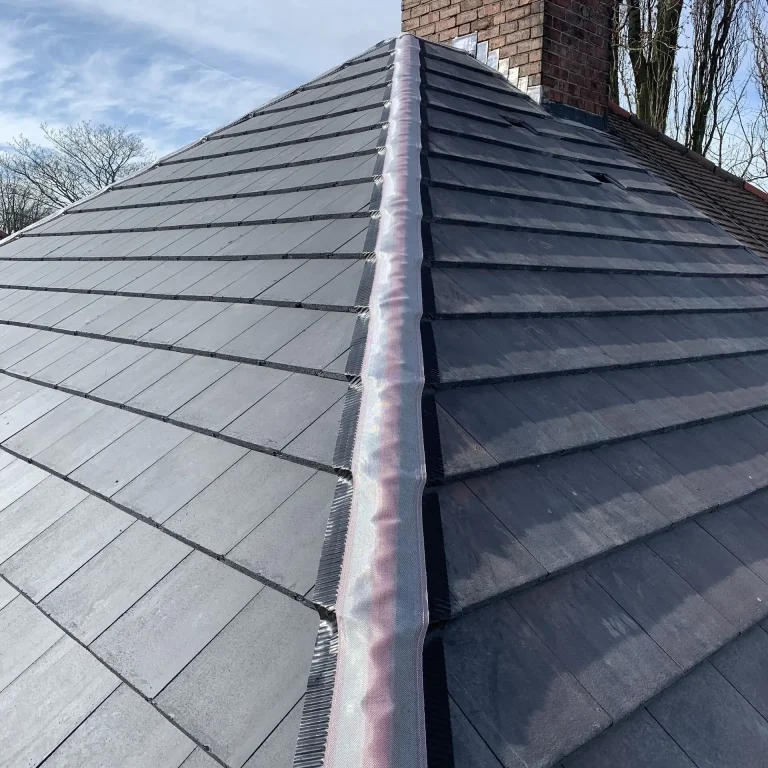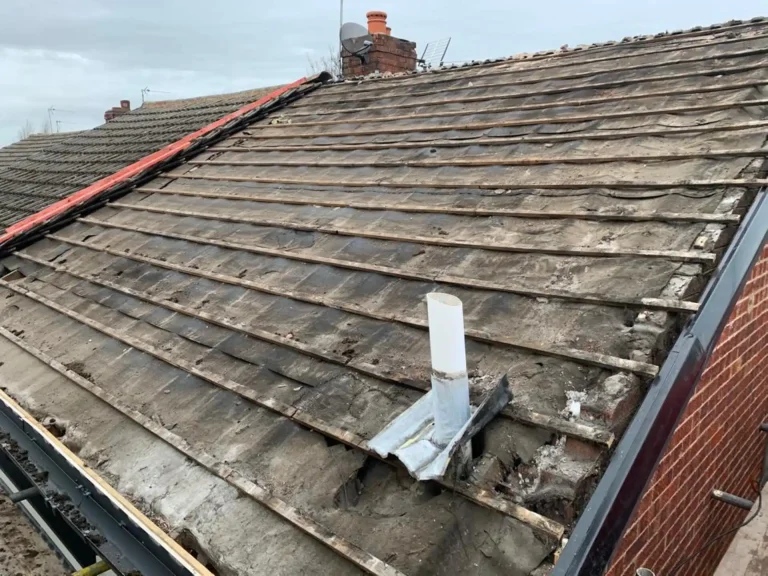
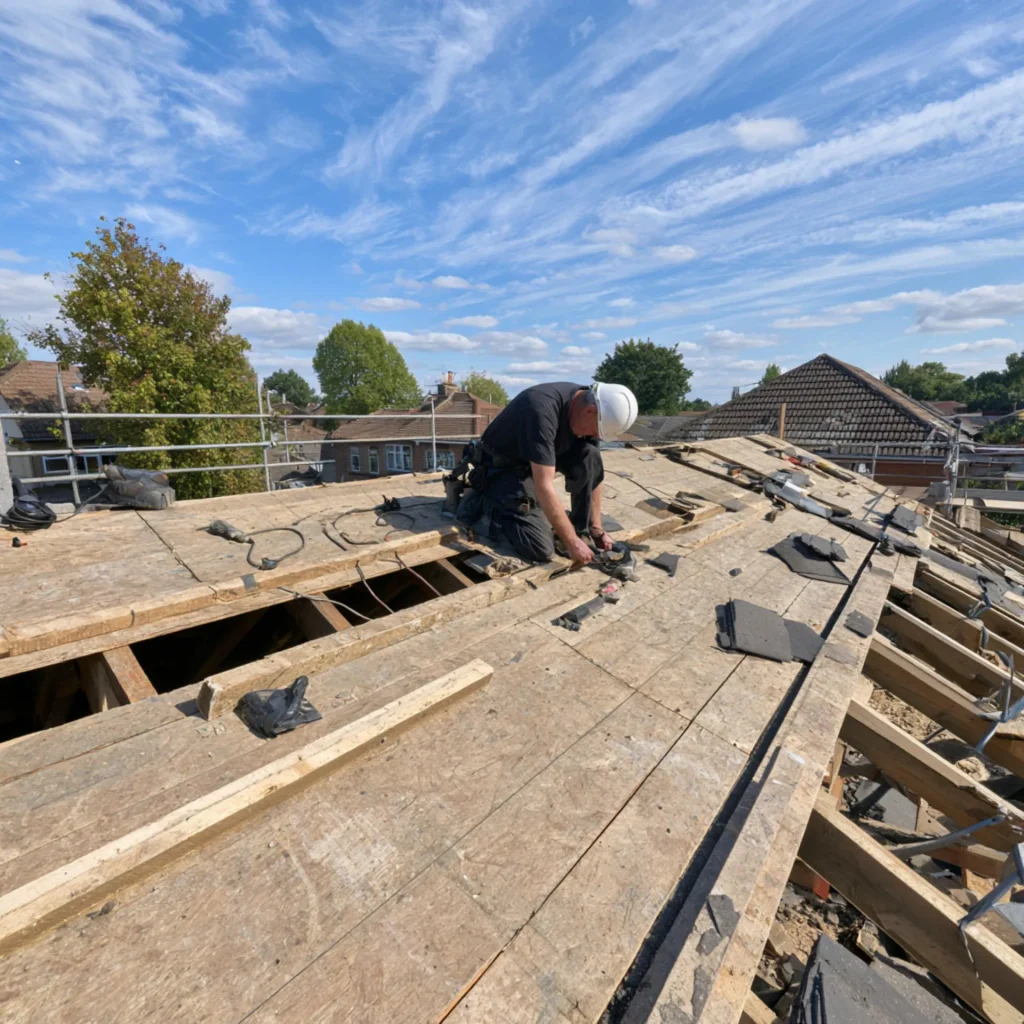
Replacing a few damaged tiles is very different from stripping and renewing an entire roof. While small, localised repairs will not normally require a Building Regulations application, a full roof replacement usually will.
Building Regulations may also apply when roofing work includes structural alterations, substantial changes to insulation, a new rooflight or a different covering that changes the weight or fire performance of the roof.
For homeowners considering roof leak repair in Liverpool, the first step should be establishing whether the problem needs a targeted repair, a wider re-covering or a complete roof replacement. That distinction can determine whether formal approval is required.
When Does a Roof Replacement Need Building Regulations Approval?
For work to an existing pitched or flat roof in England, a Building Regulations application will not normally be required when both of the following apply:
- Less than 25% of the total external building envelope is affected
- Less than 50% of the roof is affected
Approval will normally apply when the work exceeds either limit. Structural alterations, significant changes to fire performance or a new roof covering that increases the roof’s weight by 15% or more may also require approval. You will normally need approval when the work exceeds either limit. You may also need approval for structural alterations, significant fire-performance changes or a new roof covering that increases the roof’s weight by 15% or more.
The 25% figure does not refer to the roof alone. The external building envelope includes the walls, floors, roof, windows, doors, roof windows and rooflights.
The 50% figure relates specifically to the individual thermal element, which in this case is the roof. Approved Document L may require you to upgrade the entire thermal element to the required energy-efficiency standard when you renovate more than 50% of it or more than 25% of the building’s external envelope.
Because calculating these areas is not always straightforward, the safest approach is to confirm the proposed scope with your roofing contractor and building control before permanent work begins.
What Types of Roofing Work Usually Require Approval?
Building Regulations approval is commonly needed for the following projects.
Complete roof replacement:
A full roof replacement will almost always affect more than 50% of the roof. Approval is therefore likely to be required, whether the property has a tiled, slate or flat roof.
The work may need to satisfy requirements covering structural stability, insulation, ventilation, fire safety, weather resistance and workmanship.
Structural alterations:
Approval will normally be required if the work involves altering or replacing:
- Rafters
- Joists
- Trusses
- Purlins
- Structural supports
- Load-bearing roof components
Installing a rooflight, changing the roof shape or removing supports can alter how the structure transfers loads through the building.
Loft conversions in Liverpool often require careful structural planning to support new floor loads, stair openings, dormers and roof windows.
Changing the roof covering:
Replacing one covering with another may require approval if the new material significantly changes the roof’s weight.
For example, changing from a lightweight covering to heavier concrete tiles may place additional loads on rafters, purlins and supporting walls. Building Regulations approval is likely when the weight of the roof covering increases by 15% or more. A significant change in fire performance can also trigger approval.
A professional assessment should be completed before changing materials during a tile roof repair or replacement.
Replacing a flat roof membrane:
Approved Document L treats replacement of the waterproof membrane on a flat roof as renovation of a thermal element. Depending on the area affected, insulation may also need to be upgraded.
This is one reason why extensive flat roof repair and replacement should be properly assessed before the existing membrane is stripped.
Do New Rooflights Need Building Regulations Approval?
Building Regulations approval will generally be needed when installing a new rooflight or roof window.
Creating the opening will often involve cutting one or more rafters or joists. The surrounding structure may then need to be trimmed and strengthened so that loads are safely transferred around the opening. Building control may also consider thermal performance, ventilation, safety glazing, weatherproofing and means of escape.
Planning permission is a separate matter. Many rooflights can be installed under permitted development rights, but restrictions can apply to:
- Listed buildings
- Flats and maisonettes
- Properties in conservation areas
- Buildings affected by an Article 4 direction
- Rooflights that project beyond permitted limits
- Work that materially changes the building’s appearance
Anyone considering new Velux windows and rooflights should check both Building Regulations and planning requirements before installation.
Why Does Building Control Inspect Roof Replacement Work?
Building control is not simply concerned with the appearance of the finished roof. Its purpose is to check that the completed work meets the applicable technical standards.
Structural stability:
The existing structure must safely support the proposed roof covering and wind, snow and maintenance loads. A lighter covering may still require Building Regulations approval where the work involves structural alterations, insulation, fire performance or extensive replacement.
Insulation and energy efficiency:
The roof forms part of the property’s thermal envelope. During major renovation, upgrade it to the required thermal standard where feasible. When replacing the roof, improve insulation through a properly designed build-up that manages ventilation and moisture to prevent condensation.
Ventilation and condensation control:
Warm, moisture-laden air can enter the roof space from bathrooms, kitchens, bedrooms and other occupied areas. If that moisture cannot escape, it may condense on cold surfaces.
Persistent condensation can contribute to:
- Damp insulation
- Mould growth
- Timber decay
- Staining on ceilings
- Corrosion of metal fixings
- Reduced thermal performance
The correct ventilation arrangement will depend on whether the property has a cold roof, warm roof or another form of insulated roof construction.
Fire safety:
Roof coverings and the layers beneath them must provide suitable resistance to fire spread. This can become particularly important when changing from one roofing material to another or when working on terraced, semi-detached or multi-occupancy buildings.
Weather resistance:
A compliant roof must resist rain and wind and direct water safely into gutters and drainage. Pitched roofs need suitable tiles or slates, battens, underlay, ridges, valleys and flashings.
Flat roofs require effective falls, outlets, upstands and membranes, especially in exposed Liverpool and Merseyside locations prone to wind-driven rain.
Do Minor Roof Repairs Need Building Regulations Approval?
Small maintenance and repair jobs will not usually require a Building Regulations application, provided they remain below the relevant thresholds and do not include structural alterations or significant material changes.
Examples may include:
- Replacing a few slipped or broken tiles
- Repairing a small split in a flat roof covering
- Renewing a short section of lead flashing
- Repointing a limited area of ridge tiles
- Clearing or repairing gutters
- Replacing a damaged downpipe
- Repairing a minor localised leak
Even when no application is needed, the repair should leave the roof safe, secure and weather-resistant.
Arrange a professional inspection when water continues to return, damp patches spread, ceilings begin to bulge or roofing materials appear loose. Property owners should not climb onto a wet, damaged or unfamiliar roof to investigate the problem themselves.
How Do I Obtain Building Regulations Approval in Liverpool?
There are two principal ways to demonstrate compliance.
Apply through building control:
Liverpool City Council accepts applications through
Building control approval with full plans:
This route is generally suited to larger or more complex work. Detailed plans and construction specifications are examined before work begins.
Building notice:
A building notice may be suitable for certain minor domestic projects that do not require detailed plans. It cannot be used for every project, including commercial or industrial buildings and flats or apartments with shared circulation areas. Liverpool City Council requires notification before work starts and carries out inspections at appropriate stages.
A registered building control approver may also be appointed where the work and building type are within its permitted scope.
Is Planning Permission Required for a New Roof?
Planning permission and Building Regulations approval are different.
Building Regulations deal with technical standards such as structure, insulation, fire safety and ventilation. Planning permission considers development, design and the external appearance of the property.
A like-for-like roof replacement that does not materially alter the appearance of a house will not usually need planning permission.
Additional checks should be made when:
- The property is listed
- The building is in a conservation area
- An Article 4 direction applies
- The roof height, shape or pitch will change
- Different materials will alter the appearance
- Dormers or substantial roof extensions are proposed
- The property is a flat or maisonette
Liverpool has Article 4 directions covering many of its conservation areas, so homeowners should not assume that normal permitted development rights are available.
What Happens If I Replace a Roof Without Approval?
Starting work without the necessary approval can create avoidable problems.
Building control may ask you to open, alter or remove parts of the roof to prove compliance. Missing documents can also delay a future sale or remortgage, as completion or compliance certificates confirm that inspectors checked the work and approved it.
You may apply for retrospective regularisation for certain unauthorised work, but building control may charge additional fees, carry out further inspections and require corrective work. It is usually simpler and less expensive to establish the correct route before the project begins.
What About Emergency Roof Repairs?
Immediate action may be necessary when:
- Storm damage has exposed the inside of the property
- Water is reaching electrical fittings
- A ceiling appears unstable
- Tiles, slates or masonry could fall
- A damaged flat roof is allowing significant water ingress
In an emergency, the first priority is making the area safe and limiting further damage. A temporary covering or localised make-safe repair may be installed before a permanent solution is designed.
Substantial re-covering or structural work should still follow the appropriate approval process. Roofer & Builder provides emergency roofing services across Liverpool and Merseyside for urgent leaks, storm damage and unsafe roofing materials.
Roof Replacement Checklist for Homeowners
Before agreeing to a new roof, confirm:
- Whether the work is a local repair, re-covering or full replacement
- How much of the roof and external building envelope will be affected
- Whether rafters, joists or other structural components will be altered
- Whether the new covering changes the roof’s weight or fire performance
- Whether insulation and ventilation upgrades are included
- Whether planning permission or listed building consent may be required
- Whether the contractor can self-certify the work
- Who will submit applications and arrange inspections
- Who will provide the completion or compliance certificate
- What guarantees and warranties will be supplied
These details should be recorded clearly in the quotation or contract before work begins.
Arrange a Professional Roof Inspection in Liverpool
You will commonly need Building Regulations approval when replacing an entire roof, carrying out extensive re-covering, altering the structure, installing new rooflights or making significant changes to roofing materials. Minor, localised repairs will not usually require a formal application.
The right solution should always be based on the condition of the roof rather than an assumption that every leak needs a complete replacement.
Roofer & Builder inspects tiled, slate and flat roofs throughout Liverpool and Merseyside. Our team can identify the likely source of a problem, explain whether a repair or wider replacement is appropriate and provide a clear quotation for the recommended work.
Call 0151 739 0669 or contact Roofer & Builder to arrange a roof inspection and free quotation.
Building control or the relevant approving body makes the final decision on whether approval is required.