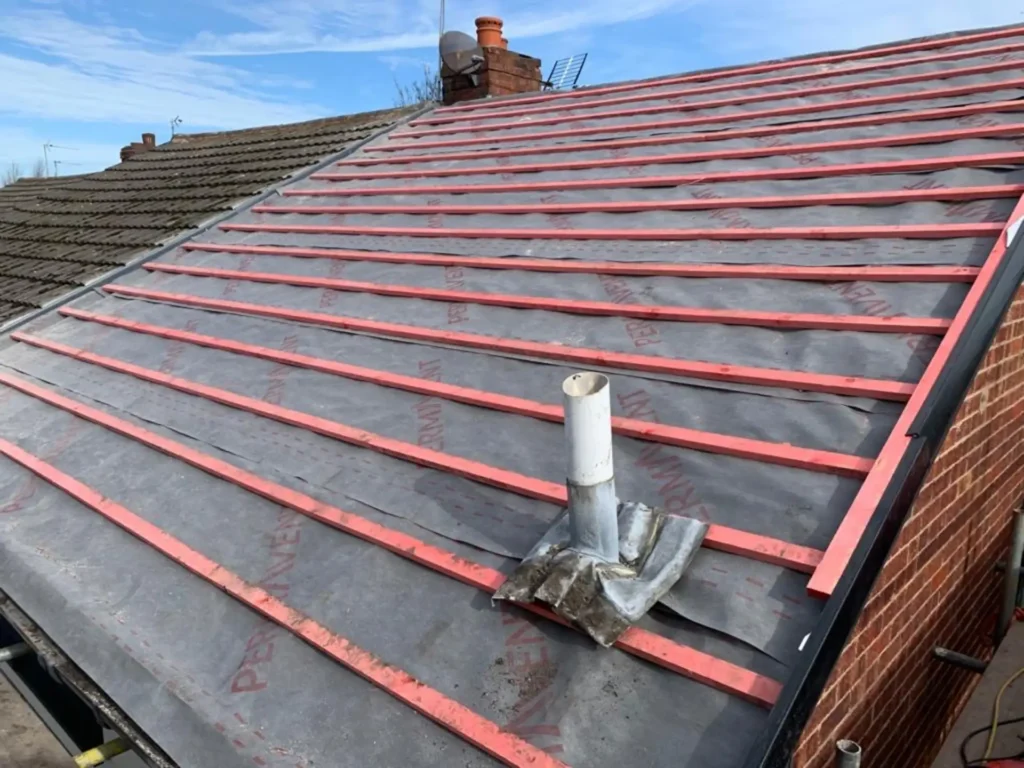
Yes, you can replace a roof in winter. A slate or tiled re-roof can carry on through most of a Merseyside winter, and the things that stop work are high wind, ice, heavy rain on a stripped section and frost on days when mortar is being laid.
Flat roofs are fussier, because the resins and adhesives used on them need a dry deck and a minimum temperature.
Plenty of homeowners put off a new roof until spring, often just after an autumn leak. Waiting isn’t always necessary.
We carry out roof replacements on tiled, slate and flat roofs across Liverpool and Merseyside from our base in Maghull, and this guide explains what we check before a winter job goes ahead and how your home stays dry while the roof is open.
The short answer
- Pitched tile and slate roofs: yes, in most weather. Work pauses for high wind, ice, heavy rain while a section is stripped, and mortar work in frost.
- Flat roofs: yes, on dry days above the minimum temperature for the system being laid. Expect to lose some days.
- Your home: only the part that can be made watertight the same day is stripped, so the house isn’t left open overnight.
Pitched Roofs: What Weather Actually Stops Work
Wind and ice stop work on a tiled or slate roof. Cold on its own usually doesn’t, apart from its effect on mortar.
High wind
Wind is the main reason a winter re-roof loses days. The Work at Height Regulations 2005 require work at height to be carried out only when “the weather conditions do not jeopardise the health or safety of persons involved in the work”.
No law sets a specific wind speed for stopping roofing work. Roofers assess the forecast and conditions on the scaffold before deciding whether to continue. Strong gusts can turn slates into hazards and cause loose underlay to behave like a sail.
Coastal properties in Crosby, Formby and Southport often experience stronger winds than sheltered inland locations, increasing the likelihood of delays.
Ice, frost and heavy rain
Frost on scaffold boards, battens and tiles makes them slippery, so a frosty morning often means a later start while surfaces thaw. That usually costs an hour or two rather than a whole day.
Rain matters most while the old covering is coming off, so a careful roofer won’t start stripping if heavy rain is due before that section can be covered. Once the new membrane and battens are on, light rain doesn’t normally stop tiling or slating.
Mortar in frost
Mortar is the one part of a pitched roof that cold weather really affects. Roofers generally stop laying it below 3°C when temperatures fall, although some manufacturers specify 5°C. Freezing before setting can weaken mortar.
Since 2014, BS 5534 has required mechanical fixings alongside mortar for ridge, hip and verge tiles. Dry-fix systems covered by BS 8612:2018 eliminate mortar and avoid frost-related delays.
If your quote includes ridge tile work, ask which fixing method your roofer will use.
Flat Roofs: Why Temperature Matters More
A flat roof can be replaced in winter, but it needs the right day: a dry deck and a temperature above the minimum for the material being laid.
The limits depend on the system:
- GRP fibreglass: Restec’s Flexitec 2020 GRP is applied in dry conditions at air temperatures of 5°C to 30°C, and not when the temperature may drop below 5°C before it cures. With Restec’s Winter Accelerator, deck temperatures of 1°C to 10°C are allowed. We’re a Restec Approved Installer, so these are the limits we work to.
- EPDM rubber: Adhesives vary by brand. ClassicBond’s water-based deck adhesive, for example, mustn’t be used if the temperature is, or will be, below 4°C within 24 hours. Every EPDM system needs clean, dry, frost-free surfaces to bond to.
- Torch-on felt: Felt is heat-applied, so it is less affected by cold than resin or water-based adhesive. The deck still has to be dry and free of frost, and cold rolls are stiffer to work.
A dry deck is the deciding factor. Moisture trapped under a new covering weakens the bond and can cause blistering later.
On a short winter day, the deck may only be dry and warm enough for a few hours around midday, which is why some flat roof days are lost even when it isn’t raining. Our flat roof page compares felt, EPDM and GRP in more detail.
How Your Home is Kept Dry While the Roof is Open
A roof is stripped in sections, and only as far as can be made watertight before the team leaves that day.
On a winter job, the routine looks like this:
- Check the forecast the evening before: If high winds or heavy rain is due, the strip is put back or kept small.
- Strip one section at a time: Old tiles or slates, battens and felt come off only as far as can be covered the same day.
- Fit the new membrane straight away: Once the breathable membrane and battens are fixed, that part of the roof sheds water before a single tile is laid.
- Sheet anything unfinished: If a section can’t be completed, it’s covered with heavy-duty temporary sheeting, battened down so the wind can’t get under it.
- Check the cover after bad weather: After a windy night, the first job of the morning is checking the sheeting and the scaffold.
On a flat roof, the old covering stays on until a suitable dry spell. If the deck boards are being replaced too, the new deck is covered the same day.
Is Winter a Good Time to Replace a Roof?
For planned work, it can be. The best time to replace a roof in the UK is usually late spring to early autumn, when the days are longer and dry spells are more reliable. Winter still has advantages if your roof is already letting you down.
Reasons to go ahead in winter:
- You choose the timing: A planned re-roof is better than an emergency repair after the next storm finds the weak spot.
- The damage stops spreading: Water getting in through the winter soaks insulation and timber, so waiting can add work to the job.
- Spring diaries fill up: Many people wait for spring, so booking a winter start can mean the work is done sooner.
Reasons to wait:
- A flat roof that is sound for now could be booked for a drier, warmer spell.
- A tired roof that isn’t letting water in may be better started in spring, with fewer weather days.
If you’re not sure whether you need a full replacement at all, our guide to roof repair or replacement explains how to tell.
When the Roof Can’t Wait Until Spring
If water is coming in now, make the roof safe first and plan the full replacement for a sensible window. A temporary repair, such as refixing slipped slates, patching a split flat roof or sheeting a damaged slope, can get a roof through the worst of the weather.
Our emergency roofing team handles make-safe repairs across Merseyside. For a leak that isn’t urgent, see our roof leak repair page. It’s also worth reading our post on winter emergency roofing mistakes, such as climbing onto a wet roof yourself.
How Long Does a New Roof Take in Winter?
Longer than in summer, mainly because of shorter days and more bad weather days. Around the shortest day, Liverpool gets about seven and a half hours of daylight, against about 17 hours in late June, so there’s less working time even when the weather is good.
Beyond that, it depends on the size and shape of the roof, the covering, any timber repairs and the number of chimneys and junctions. We’ll give you an expected timescale with your quote.
When you compare quotes for a winter re-roof, ask each roofer:
- What weather will you stop work for, and who makes the call?
- How much of the roof will be stripped at once, and how will it be covered overnight?
- For a flat roof, which system will you use, and what’s its minimum temperature?
- Will the ridges and verges be dry-fixed, or bedded in mortar and mechanically fixed?
- If the weather adds days to the job, does the price stay the same?
Winter Re-Roofing FAQs
Is it cheaper to replace a roof in winter?
The season makes less difference than the roof itself. The price of a re-roof comes from its size, the covering, the scaffolding, any timber repairs and disposal of the old materials. Winter affects availability, so request a quote confirming the start date and explaining how weather delays will be handled.
Will my house get wet while the roof is off?
It shouldn’t. Roofers strip one section at a time and cover it with new membrane or temporary sheeting before leaving each day.
Can a flat roof be replaced in the rain?
No. The deck has to be dry for any flat roof covering to bond. Work waits for a dry spell, and a temporary cover protects the roof in the meantime.
Can a roof be replaced when it’s snowing?
No work is done on a roof covered in snow or ice. Snow rarely settles for long near the Merseyside coast, so it usually costs a day or two rather than weeks.
Planning a Re-Roof this Winter?
We’ll look at your roof, explain what the weather means for your job and give you a written quote with a realistic start date. Find out more about our roof replacement service, call 0151 739 0669 or request a free quote.